Paris in 24 Hours: Day 1
Paris for Business: 24 Hours to Explore the City
 Baba Mohamad Netherlands
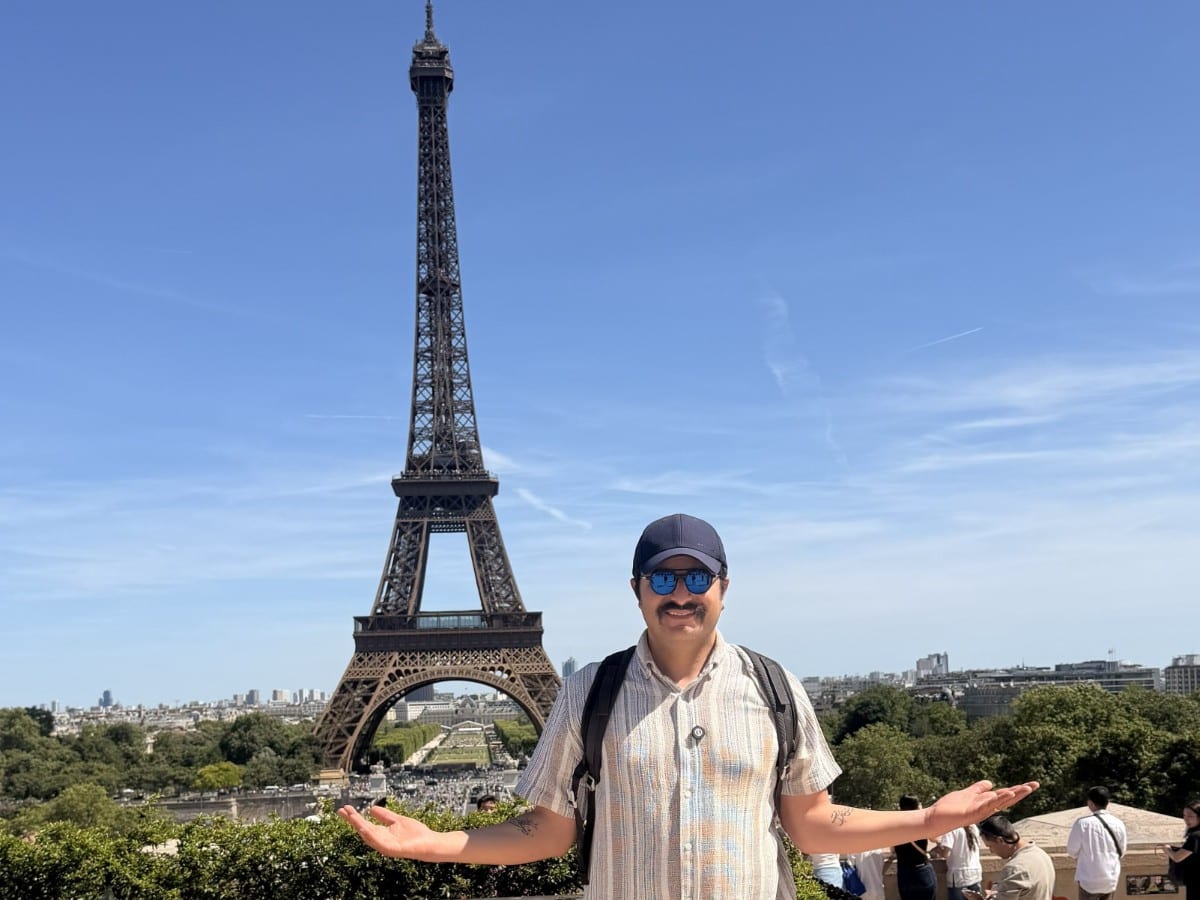
We left Groningen at midnight, drove towards Paris in a van, and reached our hotel at 10 AM. After getting some rest, we headed into the city center and made our way straight to Place du Trocadéro. Up here, you get a direct, elevated vantage point of the Eiffel Tower. That’s right where I took the header photo for this page.
When my eyes caught the Eiffel Tower, I was reminded of my childhood road trips. Driving non-stop from Tehran all the way to the Caspian coast, and that exact moment our eyes finally met the sea. It was the exact same feeling. With the only difference being that the boundless blue sea had given its place to a towering iron giant. Otherwise, both were reminders of pure peace to me.
It took a few minutes to gather myself, to believe that the scene unfolding before me was real. Sometimes, you just can't fathom the things you’ve actually achieved in life.
The platform across from Place du Trocadéro, because of its elevation, feels almost level with the Eiffel Tower. Thanks to this incredible vantage point, it is always packed with tourists and, naturally, street vendors eager to sell you souvenirs. And honestly, their prices aren’t bad either!
After snapping a few great shots with the Eiffel Tower in the background, we headed down the Trocadéro Gardens steps and made our way straight to the base of the tower. The whole area around it is wrapped in protective glass barriers, requiring a ticket just to step inside the perimeter, let alone head up. Since I only had 24 hours in Paris, I decided to stick to exploring it from the ground.
Just about 750 meters away from the Eiffel Tower lies the double-decker Pont de Bir-Hakeim. Motor traffic crosses along the lower level, while the metro runs across the top. Film buffs will instantly recognize it from movies like Inception, Mission: Impossible – Fallout, and the classic Last Tango in Paris.
Our next destination was the Louvre Museum grounds. We caught a bus and rode alongside the banks of the Seine until we reached the Pont des Arts. This is that famous bridge where lovers once wrote their names on padlocks and fastened them to the railings. The weight of these locks became so overwhelming that in 2015, the City of Paris decided to replace the metal mesh railings with glass panels!
We crossed the street and walked into the Cour Carrée (Square Courtyard), which forms part of the Louvre Palace. It’s an immense complex that, before becoming a museum, served as the primary residence and palace of the kings of France for centuries, prior to Louis XIV moving the royal court to the Palace of Versailles.
The story of the Louvre and its famous glass pyramid is fascinating in its own right.
As mentioned, Louis XIV moved the court to Versailles; afterward, the Louvre Palace became a repository to store and display the royal art collection, and following the French Revolution in 1793, its doors opened to the public.
Around 200 years later, because the palace entrances could no longer handle millions of visitors, then-President François Mitterrand commissioned the renowned Chinese-American architect I. M. Pei to design a brand-new entrance. The construction of this pyramid faced intense backlash at the time, as critics argued that dropping a modernist glass pyramid right in the center of a classical and Baroque French palace was an eyesore. Yet, once completed and paired with its stunning night illumination, the pyramid turned into one of France's most cherished landmarks.
To the west of the Louvre Pyramid stands the Arc de Triomphe du Carrousel, built in 1808 under Napoleon’s orders to celebrate the military triumphs of the French army. It bears a close resemblance to the Arc de Triomphe on the Champs-Élysées, albeit on a smaller scale.
I kept walking along the Seine, heading towards Notre-Dame Cathedral, passing several historic bridges along the way:
• Pont Neuf: translates literally to "New Bridge," but ironically it's the oldest standing stone bridge in Paris. The equestrian bronze statue of King Henry IV sits right at its center.
• Pont Saint-Michel (and Pont au Change)
...and entered the Île de la Cité, which is virtually the historic heart and cradle of Paris. Finally, I reached Notre-Dame Cathedral. One of the greatest masterpieces of Gothic architecture, its construction spanned over a century, later inspiring Victor Hugo’s famous novel The Hunchback of Notre-Dame, which helped save the monument from ruin. In 2019, it suffered a massive fire, and following years of restoration, its doors reopened to visitors in 2024.
I must admit, I would have loved to step inside, but time was short and the Parisian summer heat had thoroughly exhausted me. So, I treated myself to a refreshing mango ice cream and headed over to an Iranian restaurant called Maji for dinner. I had a mediocre koobideh with cold rice and headed back to the hotel.
Comments (0)